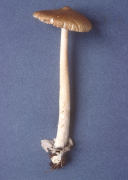
Amanita sinicoflava Tulloss Cap 2.5 x 6.5cm across, broadly bell-shaped, then convex becoming flatter with a small, distinct umbo and down curving lined margin; olive-tan to brownish olive, sometimes darker at the disk, occasionally paler at the margin; slightly sticky to dry. Gills free to narrowly adnate, close, broad; white or creamy, faintly tinged orange. Stem 68-135x6-12mm (23/4-5'/4x'/4-'/2in), hollow, tapering toward the top; whitish to graying, paler toward the top; hairy, becoming darker when handled, with faint longitudinal lines particularly near the base; no ring; no basal bulb, but remains of a whitish to gray sub-membranous sac, sometimes dotted with brown-red spots, collapsed around the base. Flesh white. Odor none. Spores subglobose or occasionally ellipsoid, nonamyloid, 9.1 - 12.2 x 8.4-11.5µ. Deposit white. Habitat singly or occasionally in small groups in sandy or loamy soil or in moss in mixed coniferous or deciduous woods. Infrequent. Found quite widely distributed in eastern North America. Season June-October. Many amanitas contain deadly toxins -avoid. |